medikon
Premium
-
Joined
-
Last visited
Everything posted by medikon
-
Hi Hanspeter, It's great how you use these chords to give the song some energy and make it sound well-rounded. (I still need to get my fingers to cooperate, though) 🎸👍
-
Unfortunately, I've missed your Guitar Lab Sessions so far. I really like the format. You're not tied to a fixed “tutorial script” and can let your thoughts run free. This fingerpicking session is great, and I'll try to tune in live in the future. Thanks for that, Hanspeter.
-
-
 amazing, thank you!
 -
-
-
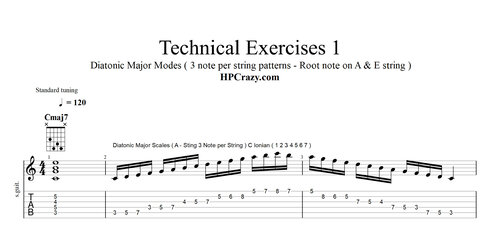
I also like this rule of thumb, which helps me to memorize the scale degrees in 3 notes per string. Described in this video by Michael Pillitiere: And of course Hanspeters famous Technical Exercise 1 https://www.hanspeterkruesi.com/members/files/file/4-technical-exercises-chords-modes-patterns-major-scales/ Uploading Attachment...
-
-
-
-
Let's start the puzzle 😉 Thanks!
-
Thank you Hanspeter, what you mentioned about 7th chords (7:30) is a cool rule of thumb! I knew that level V in the cadence should usually be a 7th chord, but I didn't know exactly why. Gemini replied to my question with this: The "rule of thumb" you're describing is not a hard-and-fast rule, but it is a very common and powerful technique. The practice of using a dominant 7th chord (V7) before a chord change is fundamental to what's known as a V-I cadence. Here's why it works and why it's so widely used: Tension and Resolution: A dominant 7th chord is inherently unstable and creates a strong sense of tension. The root of the chord is the fifth degree of the scale you are moving to (the "tonic"). The 7th of the chord creates a tritone with the 3rd, which is a very unstable interval. This tension creates a strong pull or need to resolve to the stable, tonic chord (the "I"). Creating Forward Motion: By placing a dominant 7th chord right before a new chord, you are essentially "setting up" the next chord. It creates a feeling of forward motion and expectation, making the chord change feel purposeful and satisfying. Defining the Key: This V-I relationship is the backbone of traditional harmony and is how we define a key. By playing a G7 chord, for example, the listener immediately anticipates a C major chord, which firmly establishes C as the tonic. Thanks and best regards, Roland
-
I spent a lot of time on this tutorial today. I don't know much about jazz yet. In your videos, you show us all the chords you use. But I need to dive a little deeper to really understand why, for example, an Ab9(b13) makes sense. I would like to take this opportunity to warmly recommend your accompanying data in the downloads. Your PDF with the chords is already helpful here. However, your Guitar Pro file in combination with the first-class backing track is amazing! I just added your MP3 to Guitar Pro 8 as an audio track. Both fit together perfectly right away. You are simply a pro. And not just on the instruments. Now I can slowly increase the tempo while practicing. The notes and backing track fit together perfectly at all times. Thank you for your first-class support. I can only recommend everyone to take advantage of these opportunities with the premium membership. Thanks Hanspeter 👍
-
Great News Hanspeter!! 🎸❤️👍
-
-
-
Hello Greg, that's a good thought. I've also asked myself this question. How would a hearing aid affect my daily practice on the guitar? Especially as I have to play a lot with headphones so as not to disturb the neighbors and my wife. I'll probably take them out when I'm practicing with headphones, because they are already a kind of hearing aid. I'm looking forward to your experiences. Thanks in advance, Roland
-
The topic is very exciting for me and I am also looking forward to further episodes. Again and again I have doubts about my guitar (besides my limited technical skills) and especially about my various modeling settings. I use a Line 6 HX Stomp. This is just one of many modeling devices on the market. But all these devices have one thing in common. The possibilities are overwhelming. And last but not least, I personally lack the right understanding of the crucial sequence of effects. So obviously the only correct way is to proceed step by step. Greetings, Roland
-
Hey Hanspeter, thank you for this tutorial! I have a possibly odd question. But it made me crazy for a while, because i suggested that my guitar would be out of tune. So I reall worked hard on the tuning device. And i tested the turnaround on higher strings as well.... But finally it just seems to me, that the turnaround (Ab, A, Bb up to B7) sounds in my ears a bit better or maybe just a bit more natural, when i play after the A the next note not as Bb, but as a 1/4 bended A. Is there any theoretical explanation for this, or is the reason just an old man's bad hearing in this case? I hope my question isn't totally stupid Have a nice evening and thank you!
-
-
Great, thank you Hanspeter! This short blues tutorial points to something, which I really miss quite often. Express emotions instead just playing around on licks & scales Let's talk the blues
-
Hello Hanspeter, thank you for the tutorial! Seems actually to be linked to the wrong download... (Double Stop Madness) Maybe some error on my browser side? Greets, Roland
-
I really like your new homepage! This is excellent work and finally Google is starting to reward the quality of your work with keyword rankings. Good News! By the way: The personal links are a great idea. Kind Regards, Roland
-
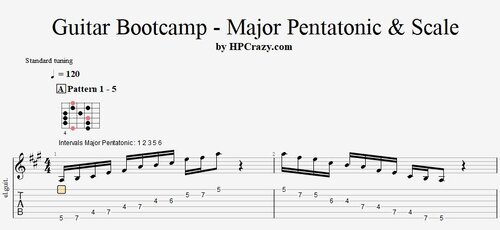
This is a very helpful blues guitar tutorial. Thank you Hanspeter! As always, well explained and easy to follow. The pentatonic positions up the fretboard and down again in one bar over 4 triplets using the blues scale. Very cool!
-
What a great tutorial! After the first few practice sessions it really starts to groove. A great song that's fun to play. As always, you've broken it down perfectly for us. The PDF and the backing track are a great help. I can only recommend everyone to have access to the downloads as a premium member. That's small money for an extremely high value. Personally, I'm a little sad that there are no more gpro files available. But of course I fully understand that. Thanks for your great work Hanspeter!